A bowl of matcha or a pot of sencha is almost entirely water, so whatever is in your tap water ends up in the cup. The two things that most often spoil green tea are chlorine, which municipal water suppliers add for disinfection and which carries a sharp, pool-like note, and very hard water, whose high mineral content can flatten the sweetness of green tea and leave a film on the surface. Japanese green teas are traditionally made with soft water, and they tend to taste their best with water that is clean, fresh and fairly low in minerals, but not completely stripped.
That gives you two levels of fix. A carbon pitcher filter is cheap and reduces chlorine taste and odour, which is the single biggest improvement for most tap water. A countertop reverse osmosis (RO) system goes much further: it removes most dissolved minerals and a long list of contaminants, then, in most of the models here, adds a controlled amount of minerals back so the water does not taste flat. RO systems need no plumbing; you fill a tank with tap water and they filter on the counter.
This guide compares five countertop RO systems and one pitcher filter sold on Amazon, explains what to look for when your main use is tea, and sets out what each costs to keep running, because the filters are the long-term expense.
Only need better water for matcha? Filtering is half the job; the other half is temperature. See our best matcha kettle guide for kettles that hold 70–80°C.
As an Amazon Associate, Matcha Spot earns from qualifying purchases, at no extra cost to you. How we choose and check products. Prices checked on October 31, 2026. Prices and availability are accurate as of that date and subject to change; the price shown on Amazon at the time of purchase applies.
Our top picks
 Best overall for tea
AquaTru Glass Carafe Alkaline RO Purifier
4-stage RO with a mineral filter, a glass carafe and clearly stated filter lives. The listing names tea among its uses.
Check price on Amazon Best value RO
Waterdrop C2SL Countertop RO with Minerals
Adds calcium, magnesium and potassium back for a rounder taste, with a self-filling glass pitcher.
Check price on Amazon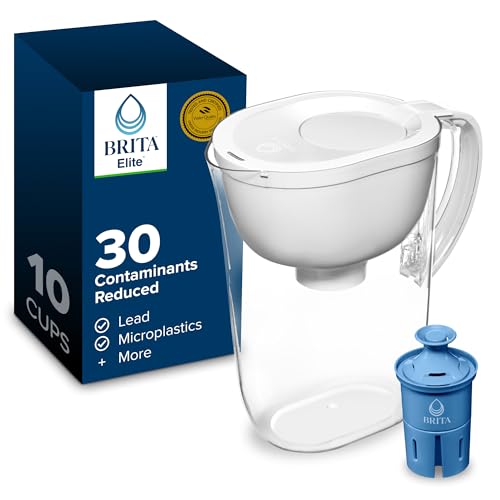 Best budget
Brita Elite 10-Cup Water Filter Pitcher
Reduces chlorine taste and odour, the main problem for tea, for a small fraction of the cost of RO.
Check price on AmazonHow we chose
We compared filters on what matters for tea: whether they reduce chlorine, whether they add minerals back after filtering (fully stripped water can make tea taste flat), how much filtered water they hold, how long the filters last and how easy they are to live with on a counter. Contaminant claims and certifications in each review are quoted from the product's Amazon listing, which we read through Amazon's product API, and attributed to the manufacturer.
Prices and stock are checked automatically every day, so the price on each card is current as of the date in the disclosure above. We have not lab-tested these filters or measured their output water. If you have a specific water-quality concern, such as lead from old pipes, check your local water report and the certification documents for the exact contaminant before you buy.
The 6 best water filters for tea
AquaTru Glass Carafe Alkaline RO Purifier
- Filtration 4-stage reverse osmosis with VOC carbon, pH and mineral boost filter
- Certification Tested and certified to NSF standards by IAPMO (per AquaTru)
- Filter life Pre/carbon 6 months, RO 1 year, VOC/mineral 1 year (per listing)
- Size 13 x 14 x 7.5 inches
- Warranty 1 year, 30-day money-back guarantee
The Glass Carafe is the AquaTru we would point most tea drinkers to. AquaTru says its 4-stage reverse osmosis is tested and certified to NSF standards by IAPMO to reduce 84 contaminants, including PFOA and PFOS, arsenic and microplastics. The final stage is a VOC carbon filter with what AquaTru calls a pH and mineral boost, so the water is not left completely stripped, which matters for green tea.
It is also the most practical size for a tea routine. You fill the tank with tap water, and filtered water dispenses into a removable glass carafe with a lid that can go straight to the fridge or the kettle. The listing names tea and coffee among its intended uses.
The filter schedule is spelled out clearly: the pre/carbon filter lasts 6 months or 300 gallons, the RO filter 1 year or 600 gallons, and the mineral filter 1 year or 300 gallons, according to AquaTru.
- Mineral boost stage avoids flat-tasting water
- Glass carafe, convenient for the kettle and fridge
- Clearly stated filter lives
- 30-day money-back guarantee, according to the listing
- Sold by a third-party seller (Ideal Living Direct), not Amazon.com
- Three separate filters to track and replace
Best for: Tea and matcha drinkers who want thorough filtration with minerals added back, in a size that suits a kitchen counter.
Skip if: Your only issue is chlorine taste; a pitcher filter is far cheaper.

AquaTru Classic Alkaline Countertop RO Purifier
- Filtration Patented 4-stage reverse osmosis (per AquaTru)
- Certification Certified to NSF standards to reduce 84 contaminants (per AquaTru)
- Tank 1-gallon tap water tank
- Filter life 6 months to 2 years, depending on filter
- Size 20 x 11 x 16.25 inches, 22.84 lb
The Classic Alkaline is the larger AquaTru, built for a household that goes through a lot of filtered water. AquaTru says it is certified to NSF standards to reduce 84 contaminants, naming fluoride, lead, chlorine, microplastics and PFOA/PFOS, using a patented 4-stage RO system. The title says it adds minerals back.
Its 1-gallon tap water tank means fewer refills than the smaller models here, and AquaTru says each filter set replaces up to 4,500 plastic bottles, with filters lasting between 6 months and 2 years depending on the stage.
The trade-off is size. At 20 inches tall and over 16 inches wide, according to the listing dimensions, it takes a lot of counter space and will not fit under many wall cabinets. For one or two tea drinkers the Glass Carafe model is easier to live with.
- Large 1-gallon tap water tank
- Wide list of contaminant reductions, according to AquaTru
- Tool-free filter changes
- Very large: 20 inches tall and nearly 23 lb
- The most expensive filter here
- Sold by a third-party seller, not Amazon.com
Best for: Larger households that want RO water for tea, cooking and drinking from one machine.
Skip if: Counter or cabinet space is limited.

Bluevua RO100ROPOT Countertop RO System
- Filtration 5-stage RO including a remineralization filter
- Certification WQA and NSF certified (per listing title)
- Filter life 12 to 24 months (per Bluevua)
- Efficiency 2:1 pure to drain ratio
- Size 14.3 x 10.9 x 15.4 inches, 11 lb
Bluevua's main selling point for tea drinkers is the filter life. The listing says its filters last between 12 and 24 months, and a monitor display shows remaining filter life and water quality, so you can see when it is time to change them rather than guessing.
Filtration is five stages, including a remineralization filter that, according to Bluevua, enriches the water with minerals to balance taste. Bluevua claims the system filters out 99.9% of possible contaminants. Like the AquaTru Glass Carafe, it dispenses into a carafe made of high borosilicate glass instead of plastic.
It has a 2:1 pure to drain ratio, which is less efficient than the 3:1 of the DREO and Waterdrop, so more of the water you pour in ends up in the drain tank.
- Longest stated filter life here, 12 to 24 months
- Display shows filter life and water quality
- Remineralization stage and glass carafe
- 2:1 pure to drain ratio wastes more water than 3:1 models
- Sold by the brand's own store, not Amazon.com
- Contaminant claim is a broad percentage rather than a named list
Best for: Tea drinkers who want the fewest filter changes and an on-screen reminder.
Skip if: You want the most water-efficient system or detailed contaminant figures.

DREO Countertop RO Water Filter
- Filtration 7-in-1 reverse osmosis
- Testing Tested by SGS meeting NSF/ANSI 58 standards (per DREO)
- Display TDS and filter life
- Efficiency 3:1 pure to drain ratio
- Extras 2 autofill pitchers, self-cleaning, 5L size
The DREO is the only RO system here sold and shipped by Amazon.com, which makes returns simple. DREO says its 7-in-1 RO filter removes 99.9% of possible contaminants, including PFOA, PFOS, chlorine and fluoride, and that it was tested by SGS as meeting NSF/ANSI 58 standards.
For tea, the useful extra is the TDS display. TDS (total dissolved solids) is a rough measure of how much is dissolved in the water, mostly minerals, so it lets you see how soft your filtered water is. It also shows filter life, comes with two pitchers that fill automatically, and has a 3:1 pure to drain ratio, according to the listing.
The listing does not say whether it adds minerals back, and it does not state a filter replacement interval, so rely on the filter life display. If your tea tastes flat with fully filtered water, a remineralizing model such as the Waterdrop may suit you better.
- Sold and shipped by Amazon.com
- TDS and filter life display
- Efficient 3:1 pure to drain ratio
- Two autofill pitchers
- Listing does not mention a mineral stage
- No filter replacement interval stated in the listing
Best for: Buyers who want an RO system with easy Amazon returns and a TDS readout.
Skip if: You want minerals added back for a rounder-tasting cup.
Waterdrop C2SL Countertop RO with Minerals
- Filtration 7-stage RO, 0.0001 μm membrane
- Minerals Adds calcium, magnesium, potassium and sodium
- Capacity 108 oz feed tank, 40 oz glass pitcher
- Filter life Up to 528 gallons or 12 months (per Waterdrop)
- Efficiency 3:1 pure to drain ratio
The C2SL is the most affordable RO system here and the one most clearly aimed at taste. Waterdrop says its mineral filter adds calcium, magnesium, potassium and sodium back to the filtered water to avoid the flat taste often associated with RO, and the listing names tea and coffee among its uses.
Waterdrop reports SGS laboratory tests showing 99.51% reduction of chlorine, 99.83% of lead, 98.45% of fluoride, 99.8% of PFOA, 99.7% of PFOS and 99.96% of microplastics under laboratory conditions.
The 108 oz feed tank refills a 40 oz glass pitcher automatically, and voice alerts tell you when the tank is low or a filter is due. Waterdrop describes it as designed for 1 to 2 people, with filters lasting up to 528 gallons or 12 months.
- Adds minerals back for a balanced taste
- Detailed, attributed contaminant test figures
- Compact, with a fridge-friendly glass pitcher
- Efficient 3:1 pure to drain ratio
- Sized for 1 to 2 people
- 40 oz pitcher is small for a household that drinks a lot of tea
- Sold by the brand, not Amazon.com
Best for: One or two tea drinkers who want RO water that still has some minerals.
Skip if: You need a large volume of filtered water every day.
Brita Elite 10-Cup Water Filter Pitcher
- Filter Brita Elite, replace about every 6 months (per Brita)
- Reduces Chlorine taste and odour, 99% of lead, and more (per Brita)
- Certification WQA and NSF/ANSI certified (per listing title)
- Capacity 10 cups, fits in most fridges
- Extras Electronic filter indicator, BPA-free
If your tap water is reasonably soft and the problem is a chlorine taste in your tea, a pitcher filter is all you need, and it costs a small fraction of any RO system. Brita says the Elite filter reduces chlorine taste and odour, 99% of lead, cadmium, mercury, benzene and asbestos, among others, and the listing title says it is WQA and NSF/ANSI certified and reduces 30 contaminants.
The Elite filter is Brita's longer-lasting one: Brita says to replace it about twice a year, roughly every 6 months, and an electronic indicator reminds you. The 10-cup pitcher fits in most fridges.
What it does not do is soften very hard water. A carbon filter removes taste and odour compounds, not most dissolved minerals, so if your kettle scales quickly and your tea has a film on top, an RO system is the bigger improvement.
- By far the most affordable option
- Reduces chlorine taste and odour, according to Brita
- Long-life filter with an electronic reminder
- Sold and shipped by Amazon.com
- Does not remove most minerals, so it will not soften hard water
- Filters slowly compared with RO systems
Best for: Anyone with soft or moderately hard tap water whose tea tastes of chlorine.
Skip if: Your water is very hard or you want the broadest contaminant reduction.
What water is best for green tea and matcha?
Fresh, clean, fairly soft water with a little mineral content and no chlorine.
No chlorine
Chlorine is added to most municipal water as a disinfectant. For tea, the issue is taste. Green tea and matcha have delicate, grassy and savoury flavours, and a chlorine note sits right on top of them. Carbon filters, including the carbon stages in every RO system here, reduce chlorine taste and odour.
Soft, but not empty
Hard water carries a lot of calcium and magnesium. In green tea that tends to mute sweetness and umami, and it can leave a dull film on the surface of the cup. At the other extreme, water with almost no minerals at all, such as distilled water, can make tea taste flat and thin. That is why most RO systems here add a measured amount of minerals back after filtering.
Fresh and not over-boiled
Use freshly filtered water and avoid boiling the same water over and over, which concentrates whatever is left in it. For matcha, heat to 70–80°C rather than boiling; for sencha, around 70–80°C; for gyokuro, cooler still. See matcha vs sencha for how the teas differ.
Pitcher filter or reverse osmosis?
Start with your water. Your water supplier publishes an annual water quality report, often called a Consumer Confidence Report in the US, that lists hardness and other measurements. Quick signs: fast-building white scale in the kettle means hard water; a pool-like smell means chlorine.
- Soft water that tastes of chlorine: a pitcher filter such as the Brita Elite fixes the main problem cheaply.
- Hard water, or scale in the kettle: an RO system removes most of the minerals. Choose one that adds a controlled amount back (AquaTru, Bluevua, Waterdrop) so tea does not taste flat.
- Specific contaminant concerns: check what each system is certified or tested for, as quoted above, and read the certification details on the manufacturer's site.
An RO system also has a side benefit for tea equipment: low-mineral water means much less scale in your kettle, which keeps a temperature-control kettle heating accurately for longer.
What to look for in a water filter for tea
A mineral or remineralization stage
For tea, this is the most important RO feature. Waterdrop, AquaTru and Bluevua all describe a stage that adds minerals back. The DREO listing does not mention one.
Certifications, read carefully
Look at what a certification actually covers. NSF/ANSI 58 is the standard for RO systems; NSF/ANSI/CAN 372 covers lead-free materials in the product, not what the filter removes. Lab tests reported by the brand, such as SGS results, are useful but are not the same as an independent certification. We quote each claim as the listing states it.
Pure to drain ratio
RO systems send part of the water you pour in to a drain tank. A 3:1 ratio (DREO, Waterdrop) wastes less than 2:1 (Bluevua).
Running costs: how often you replace the filters
The machine is a one-off purchase; replacement filters are the ongoing cost, and they vary more than the sticker prices suggest. Here is what each listing says about filter life. Actual life depends on how hard your tap water is and how much you filter.
- AquaTru Glass Carafe: pre/carbon filter every 6 months or 300 gallons; RO filter every year or 600 gallons; VOC carbon and mineral filter every year or 300 gallons.
- AquaTru Classic Alkaline: filters last 6 months to 2 years depending on the stage, according to AquaTru, with each filter set replacing up to 4,500 plastic bottles.
- Bluevua RO100ROPOT: 12 to 24 months, with a display showing remaining life. The fewest changes here.
- DREO RO Filter: the listing does not state an interval; follow the filter life display.
- Waterdrop C2SL: up to 528 gallons or 12 months, whichever comes first.
- Brita Elite Pitcher: about every 6 months, so two filters a year. The cheapest to run by a wide margin.
To compare fairly, check the current price of each brand's replacement filter set on Amazon and divide by its stated life. Changing filters on time matters for taste as well as filtration: an exhausted carbon stage lets chlorine back through, and you will notice it in green tea first.
Good water is one part of a premium tea setup. For the rest, see our premium matcha equipment guide.
Side-by-side comparison
| Filter | Type | Adds minerals | Filter life (per listing) | Best for |
|---|---|---|---|---|
| AquaTru Glass Carafe | 4-stage RO | Yes | 6 to 12 months by stage | Tea overall |
| AquaTru Classic Alkaline | 4-stage RO, 1 gal tank | Yes | 6 months to 2 years | Large households |
| Bluevua RO100ROPOT | 5-stage RO | Yes | 12 to 24 months | Fewest filter changes |
| DREO RO Filter | 7-in-1 RO, TDS display | Not stated | Not stated, shown on display | Amazon returns |
| Waterdrop C2SL | 7-stage RO | Yes | Up to 12 months | Value RO |
| Brita Elite Pitcher | Carbon pitcher | No | About 6 months | Chlorine taste on a budget |
Frequently asked questions
What is the best water filter for tea?
For most tea drinkers, the AquaTru Glass Carafe is our top pick: 4-stage reverse osmosis with a mineral stage, a glass carafe and clearly stated filter lives. If your water is soft and only tastes of chlorine, a Brita Elite pitcher is a much cheaper fix.
Is filtered water better for matcha?
Usually, yes. Matcha is mostly water, and chlorine or very hard water can mask its sweet, savoury flavour. Filtering out chlorine is the biggest improvement for most tap water.
Is reverse osmosis water good for tea?
It can be, but water with almost no minerals can make tea taste flat. Many countertop RO systems, including the AquaTru, Bluevua and Waterdrop models in this guide, add a measured amount of minerals back after filtering for a rounder taste.
Should I use distilled water for tea?
Generally no. Distilled water has almost no minerals, and most people find tea made with it tastes thin. Soft, filtered water with some mineral content is the usual recommendation.
Does a Brita filter make tea taste better?
If your tap water tastes of chlorine, yes. Brita says the Elite filter reduces chlorine taste and odour. It does not remove most dissolved minerals, so it will not soften very hard water.
How often do I need to change the filters?
It depends on the system. According to the listings, the Brita Elite filter lasts about 6 months, the Waterdrop C2SL up to 12 months, the Bluevua 12 to 24 months, and the AquaTru filters between 6 months and 2 years depending on the stage.
Find matcha cafés near you
Taste great matcha before you buy: find the best matcha cafés in your city.
Find Matcha Near Me