Most people's first matcha is a sweet café latte, and their first attempt at home is bitter, grassy and lumpy. That gap is rarely about talent. It usually comes down to three things: the matcha itself (cheap or stale powder tastes harsh), water that is too hot, and powder that was never sifted or properly mixed. Fix those three and a homemade cup can be as smooth as a good café's.
This guide is for anyone buying matcha for the first time. It picks five products that are easy to get right: a smooth ceremonial tin for drinking plain, a ceremonial blend aimed at lattes, an affordable organic culinary matcha, a complete starter set and a handheld frother for people who would rather not whisk. Then it explains the grades, walks you through your first cup, and covers the mistakes that put most beginners off.
The short answer: if you want to taste what matcha really is, start with a small tin of ceremonial grade and drink it plain at least once. If you already know you like matcha lattes, a latte-focused ceremonial or a culinary grade is the sensible, cheaper start. Either way, buy a small tin, not a big bag.
New to matcha altogether? Start with what is matcha for the basics: how it is grown, why it is ground into powder, and how it differs from ordinary green tea.
As an Amazon Associate, Matcha Spot earns from qualifying purchases, at no extra cost to you. How we choose and check products. Prices checked on October 31, 2026. Prices and availability are accurate as of that date and subject to change; the price shown on Amazon at the time of purchase applies.
Our top picks
 Best first ceremonial
Naoki Matcha Superior Blend
First-harvest Uji matcha that the listing describes as smooth, with balanced umami and only a hint of bitterness.
Check price on Amazon Best for lattes on a budget
Jade Leaf Organic Culinary Grade Matcha
Organic culinary grade with nothing added: the most affordable way to start making lattes and smoothies.
Check price on Amazon Best starter set
Soeos Matcha Starter Set
Matcha plus a bamboo whisk, bowl, sifter, scoop and stand in one box, sold by Amazon.com.
Check price on AmazonHow we chose
We compared matchas and tools on what matters most to a beginner: how forgiving the matcha is likely to be (grade, harvest and what the brand says about flavour), whether it is meant for plain matcha, lattes or both, tin size, and whether it is in stock from Amazon or the brand itself. Product details come from each item's Amazon listing, which we read through Amazon's product API.
Prices and stock are checked automatically every day, so the price on each card is current as of the date in the disclosure above. We have not lab-tested or taste-tested these products for this guide; flavour descriptions and other claims come from the brands' listings, and we say so where we use them.
The 5 best matcha picks for beginners
Naoki Matcha Superior Blend
- Grade Ceremonial, first harvest, shade-grown
- Origin Uji, Kyoto, Japan
- Size 40g (1.4 oz) tin
- Servings 20 per tin, 1 tsp (2g) per cup (per Naoki)
- Seller Naoki Matcha
The Superior Blend is the matcha we would hand to someone who wants to know what good matcha tastes like. Naoki's listing describes it as first-harvest, shade-grown ceremonial matcha from Uji, the region most associated with Japanese matcha, and calls it smooth with balanced umami and only a tiny hint of bitterness. That last point is exactly what a beginner needs: a forgiving tea that does not punish a slightly-too-hot kettle.
It is also versatile: Naoki recommends it for both usucha (thin matcha whisked with water) and lattes. According to the listing, the tea is ground just before it leaves Japan and sealed into airtight packets, which helps freshness.
The 40g tin gives about 20 cups at 2g each, a sensible amount to finish while it is still fresh. It costs more per gram than a culinary matcha, so it is wasted in smoothies or baking.
- Described by Naoki as smooth with only a hint of bitterness
- Works plain and in lattes
- First-harvest Uji matcha, ground shortly before export (per the listing)
- 40g tin is a sensible size to finish fresh
- Pricier per gram than culinary or latte blends
- Sold by the brand rather than Amazon.com
Best for: Beginners who want to drink matcha plain and taste what good ceremonial grade is like.
Skip if: You only plan to make sweet lattes, smoothies or bakes; a culinary grade does that for less.
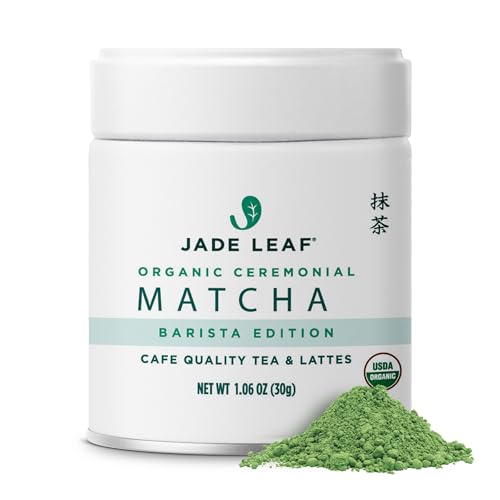
Jade Leaf Ceremonial Barista Edition
- Grade Ceremonial, first harvest (ichibancha)
- Certification USDA Organic
- Size 30g (1.06 oz) tin
- Servings About 15 lattes or up to 30 usucha (per Jade Leaf)
- Seller Jade Leaf Matcha
Jade Leaf's Barista Edition is a ceremonial matcha blended with lattes in mind. The listing describes a café-style blend of first-harvest leaves, shade-grown for up to four weeks, with an exceptionally smooth taste, light nutty notes and balanced umami. It is USDA Organic.
For a beginner, it sits in a useful middle ground. It is ceremonial, so it can be whisked with water and drunk plain, but it is built to hold its own against milk, which is how most new matcha drinkers start. Jade Leaf says the 30g tin makes about 15 full-size lattes at half to one teaspoon each, or up to 30 traditional servings.
One caution: the listing's directions suggest water just under boiling. We recommend 70–80°C to avoid bitterness, which matters more for a beginner than any brand instruction. Jade Leaf also recommends refrigerating the tin after opening and using it within 30 to 60 days.
- Ceremonial grade that suits both lattes and plain matcha
- USDA Organic, first harvest
- Small 30g tin, easy to finish fresh
- Clear storage guidance from the brand
- Smaller tin than the Naoki
- Listing's suggested water temperature is hotter than we recommend
Best for: Beginners who mostly drink lattes but want a matcha good enough to try plain.
Skip if: You want the smoothest possible matcha for drinking with water only; the Naoki is aimed more at that.
Jade Leaf Organic Culinary Grade Matcha
- Grade Culinary
- Certification USDA Organic, nothing added
- Size 30g (1.06 oz) resealable pouch
- Sourcing Uji and Kagoshima partner farms (per Jade Leaf)
- Uses Lattes, smoothies and baking
If you already know you like matcha lattes, smoothies or matcha baking, culinary grade is the sensible, low-risk way to start. This is the most affordable matcha in this guide. Jade Leaf's listing describes it as 100% USDA Organic matcha with nothing added, finely ground for a smooth, rich flavour and vibrant colour, sourced from partner farms in Uji and Kagoshima.
Culinary matcha is made to be mixed. Its flavour is generally stronger and more astringent than ceremonial grade, which helps it come through milk, sugar and fruit. That same strength is why it can taste harsh drunk plain with water, so treat it as an ingredient rather than your introduction to matcha tea.
It comes in a resealable pouch rather than a tin. Squeeze out the air after each use, or move it to an airtight matcha container.
- The most affordable way to start with matcha lattes
- USDA Organic with nothing added
- Works for lattes, smoothies and baking
- Small pack, so it stays fresh
- Not designed for drinking plain with water
- Pouch is less protective than a tin
Best for: Beginners who want matcha lattes, smoothies or bakes without paying ceremonial prices.
Skip if: You want to drink matcha plain; buy a ceremonial tin instead.
Soeos Matcha Starter Set
- Matcha 2 oz tin included
- Whisk 100-prong bamboo chasen
- Also includes Ceramic bowl, stainless steel sifter, bamboo scoop, whisk stand, scoop rest, tea towel
- Seller Amazon.com
The Soeos set is the simplest way to get everything for traditional matcha in one order. According to the listing, the box contains a 2 oz tin of matcha, a 100-prong bamboo whisk carved from a single piece of bamboo, a ceramic matcha bowl, a stainless steel sifter, a bamboo scoop, a whisk stand, a scoop rest and a tea towel.
The sifter is the underrated part for beginners. Sifting is the single easiest fix for lumpy matcha, and many people skip it simply because they do not own one. The whisk stand matters too: it lets the bamboo dry in shape, which makes the whisk last longer. See our chasen guide for how to use and care for it.
Soeos describes the included matcha as finely ground with a smooth, mellow flavour, but the listing does not state its grade or origin. Treat the set as the tools plus a starter tin, and pair it with a ceremonial matcha from this list if you want to be sure what you are drinking.
- Every tool for traditional matcha in one box
- Includes a sifter and whisk stand, often missing from cheaper kits
- Sold and shipped by Amazon.com
- Gift-ready packaging
- Listing does not state the matcha's grade or origin
- Bamboo whisks need care to last
Best for: Beginners who want the full traditional ritual, or a gift for someone curious about matcha.
Skip if: You only plan to make lattes with a frother; you will not use most of the set.

Zulay Kitchen Handheld Milk Frother
- Motor 13,000 RPM (per Zulay)
- Whisk Stainless steel, 25 spiral rings
- Power 2 Duracell batteries, included
- Guarantee Lifetime guarantee (per Zulay)
- Seller Zulay Deals
A bamboo whisk takes a little practice. A handheld frother takes none, which is why it is often the best first tool for a matcha beginner. Zulay's listing quotes a 13,000 RPM motor and a stainless whisk with 25 spiral rings, and lists matcha among the drinks it is designed for. It mixes powder and water into a smooth, lightly foamed shot in seconds, and the same tool froths milk for a latte.
It runs on two included batteries, cleans by running the whisk briefly in water, and Zulay backs it with a lifetime guarantee, according to the listing.
The foam is not quite the fine, dense crema a good bamboo whisk makes on traditional matcha, and it does not heat milk. For lattes that hardly matters. See how to make matcha without a whisk for the method.
- No technique needed: smooth matcha in seconds
- Also froths milk for lattes
- Cordless, batteries included
- Very affordable
- Foam is coarser than a well-used bamboo whisk
- Does not heat milk
Best for: Beginners who want smooth matcha and lattes without learning to whisk.
Skip if: You want the traditional ritual, or you need hot frothed milk (an automatic frother does that).
Matcha grades explained: ceremonial, latte and culinary
Matcha is sold in grades, and the grade is the single biggest factor in how a beginner's first cup tastes. There is no official, regulated grading system, so the names are partly marketing, but they do tell you what the brand intends the tea to be used for.
Ceremonial grade
Ceremonial matcha is meant to be whisked with water and drunk plain. It is usually made from younger, first-harvest leaves that are shade-grown before picking, which gives a brighter green colour, more sweetness and umami, and less bitterness. It is the most expensive grade and the best introduction to what matcha tastes like. The Naoki Superior Blend and Jade Leaf Barista Edition in this guide are both sold as ceremonial.
Latte or barista blends
Many brands now sell a blend aimed at lattes. These are often labelled ceremonial but formulated to keep their flavour when mixed with milk and sweetener. Jade Leaf's Barista Edition is an example.
Culinary grade
Culinary matcha is made for mixing into lattes, smoothies and baking. It typically uses later-harvest leaves and has a stronger, more astringent taste that comes through other ingredients. It costs much less, and it is the right choice for anything sweet or blended, but drunk plain with water it can taste harsh. For a deeper comparison, see ceremonial vs culinary matcha.
Signs of a good beginner matcha
- Origin stated clearly. Japanese regions such as Uji, Kagoshima or Nishio are a good sign. Vague origins are a reason for caution.
- A small tin or pouch. 30 to 40g is ideal for a first purchase.
- Realistic pricing. Very cheap "ceremonial" matcha is rarely what it claims. See how to spot fake matcha.
How to make your first cup of matcha, step by step
This makes one cup of usucha, the everyday thin style of matcha. It takes about two minutes.
- Heat the water to 70–80°C (160–175°F). If you do not have a temperature-control kettle, boil the water and let it stand for three to five minutes, or add a splash of cold water. This is the most important step: boiling water is the main reason first-time matcha tastes bitter.
- Sift the matcha. Push 1 teaspoon (about 2g) of matcha through a small fine-mesh sieve into a bowl or wide mug. Matcha clumps naturally, and sifting is the easiest way to avoid lumps.
- Add a little water first. Pour in about 2 oz (60 ml) of the hot water. Starting with a small amount makes it much easier to whisk smooth.
- Whisk or froth. With a bamboo whisk, move it quickly in a W or M shape from the wrist, not in circles, for 15 to 20 seconds until there are no lumps and a layer of fine foam forms. With a handheld frother, hold it just below the surface for 10 to 15 seconds.
- Taste, then adjust. Drink it as it is, or top up with more hot water for a lighter cup. Next time, use a little less powder if it was too strong, or a little more if it was weak.
Bamboo whisk or frother?
A bamboo whisk (chasen) makes the finest foam and is part of the ritual, but it takes some practice and care. A handheld frother gives smooth results from the first try. If you are unsure, start with a frother and buy a whisk later. A temperature-control kettle takes the guesswork out of step one, and our matcha starter kit guide covers the other tools.
Matcha latte or plain matcha: where should a beginner start?
There is no wrong answer, but the choice affects what you buy.
Start with a latte if...
You already like café matcha lattes, you take your coffee with milk, or you find green tea bitter. Milk softens matcha's grassy edge, and a little sweetener rounds it off. Make a matcha shot as above, then pour it into 6 to 8 oz (180 to 240 ml) of warm or cold milk. Oat milk is a popular pairing; see oat milk matcha latte. A latte blend or culinary grade is the economical choice here. Full method: how to make a matcha latte.
Start plain if...
You are curious about matcha as a tea, you drink green tea already, or you want to judge whether a matcha is good. Plain matcha shows its real quality: a good ceremonial tea tastes sweet, savoury and only gently bitter, while a poor one tastes flat or harsh. Buy a ceremonial tin and drink it plain at least a few times, even if you go on to make mostly lattes. For an easy, forgiving middle ground, try an iced matcha latte: shake the matcha with cool water in a jar and pour it over ice and milk.
Common beginner mistakes (and how to avoid them)
- Using boiling water. It scorches the tea and brings out bitterness. Aim for 70–80°C.
- Skipping the sieve. Unsifted matcha forms lumps that no amount of whisking fully breaks up, and they taste chalky and bitter.
- Using too much powder. More is not better. Start at about 1 teaspoon (2g) per cup and adjust.
- Buying the cheapest tin available. Very cheap matcha is often old or low grade, and it is the reason many people decide they do not like matcha.
- Drinking culinary grade plain. It is made for mixing. If you want to drink matcha with water, buy ceremonial.
- Leaving the tin open or in a warm spot. Air, light and heat dull matcha's colour and flavour within weeks.
How much matcha to buy, and how to store it
Start with 30 to 40g
A typical cup uses about 2g of matcha, so a 30g tin makes around 15 cups and a 40g tin around 20. At one cup a day, that is two to three weeks, roughly how long matcha stays at its best once opened. Large 100g bags look cheaper per gram, but a beginner is likely to let much of it go stale. Buy small, find what you like, then buy more of it.
Storing matcha
- Keep it airtight. Close the lid firmly after every use, or squeeze the air out of a pouch. A dedicated matcha storage container helps if yours came in a bag.
- Keep it cool and dark. A cupboard away from the stove is fine for daily use. Many brands, including Jade Leaf, recommend the refrigerator after opening.
- Use it within one to two months of opening. Fading colour and a flat, hay-like smell are signs it is past its best. Older matcha is still fine for baking.
Side-by-side comparison
| Pick | Type | Size | Best for | Drink plain? |
|---|---|---|---|---|
| Naoki Superior Blend | Ceremonial, first harvest | 40g tin | Tasting good matcha | Yes |
| Jade Leaf Barista Edition | Ceremonial, latte-focused | 30g tin | Lattes and plain | Yes |
| Jade Leaf Culinary | Culinary, organic | 30g pouch | Budget lattes and smoothies | Not ideal |
| Soeos Starter Set | Matcha plus tools | 2 oz tin | The full ritual or a gift | Yes |
| Zulay frother | Tool | Handheld | No-whisk matcha and lattes | n/a |
Frequently asked questions
What is the best matcha for beginners?
For drinking plain, a smooth ceremonial matcha such as Naoki Superior Blend, which the brand describes as balanced with only a hint of bitterness. For lattes on a budget, Jade Leaf Organic Culinary Grade. For everything in one box, the Soeos starter set.
Should beginners buy ceremonial or culinary matcha?
Buy ceremonial if you want to drink matcha with water, because it is smoother and less bitter. Buy culinary if you mainly want lattes, smoothies or baking, because it is cheaper and its stronger flavour comes through milk and sugar.
Why does my matcha taste bitter?
Usually the water is too hot, the matcha is low grade or stale, or you used too much powder. Use water at 70 to 80°C, sift the powder, start with about 1 teaspoon per cup, and choose a fresh ceremonial tin.
Do I need a bamboo whisk to make matcha?
No. A handheld electric frother mixes matcha smoothly with no practice, and you can also shake it with water in a sealed jar. A bamboo whisk makes the finest foam and is worth buying if you enjoy the ritual.
How much matcha should I use per cup?
About 1 teaspoon, or 2 grams, with roughly 2 oz (60 ml) of water at 70 to 80°C. Use a little more for a latte, and adjust to taste.
How long does matcha last after opening?
It is at its best for roughly one to two months after opening if kept airtight, cool and away from light. After that the colour and flavour fade, though older matcha is still usable for baking.
Find matcha cafés near you
Taste great matcha before you buy: find the best matcha cafés in your city.
Find Matcha Near Me