A café matcha latte and a homemade one usually differ in one way: the milk. Cafés steam milk with an espresso machine's steam wand into microfoam, a glossy, velvety texture with tiny bubbles that blends into the matcha instead of sitting on top of it. A handheld frother whips air into milk, but it cannot heat it, and the foam it makes is stiffer and coarser. That gap is why a home latte often tastes thin even with excellent matcha.
If your household drinks espresso as well as matcha, an espresso machine with a good steam wand solves both at once. This guide compares six machines sold on Amazon, from a $226 De'Longhi with a manual wand to a $1,000 Breville that textures milk automatically, and explains which features actually matter when your main drink is a matcha latte rather than a flat white.
One thing to know before you start: you never put matcha through the espresso part of the machine. You whisk the matcha separately with hot water, then use the machine to steam the milk. So the question for matcha drinkers is mostly about the milk system, and how much skill it asks of you.
Only drink matcha, not coffee? You do not need an espresso machine. An automatic milk frother heats and foams milk for a fraction of the price; see our best matcha frother guide.
As an Amazon Associate, Matcha Spot earns from qualifying purchases, at no extra cost to you. How we choose and check products. Prices checked on October 31, 2026. Prices and availability are accurate as of that date and subject to change; the price shown on Amazon at the time of purchase applies.
Our top picks
 Best for matcha lattes
Breville Bambino Plus
Automatic steam wand: set milk temperature and texture, and it makes microfoam for you.
Check price on Amazon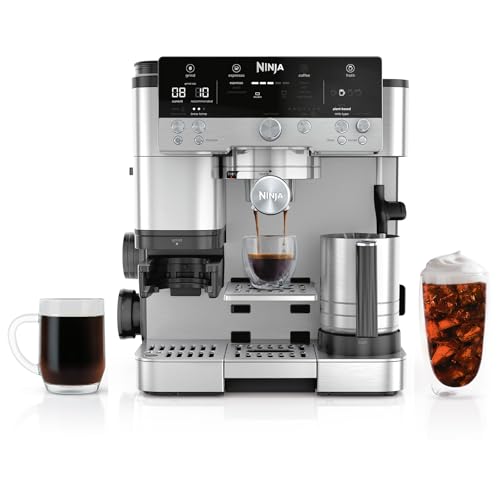 Most hands-off
Ninja Luxe Café Premier 3-in-1
Pour in milk, choose a preset, walk away. Also makes drip coffee and cold brew.
Check price on Amazon Best value
De'Longhi Classic Signature
A real steam wand and 15-bar pump for well under half the price of the rest.
Check price on AmazonHow we chose
We compared machines on what matters for a matcha latte: how the milk is steamed (automatic wand, manual wand or frothing system), how much practice it takes to get consistent milk, how big the machine is, and whether it is sold and shipped by Amazon.com. Specifications in each review come from the product's Amazon listing, which we read through Amazon's product API.
Prices and stock are checked automatically every day, so the price on each card is current as of the date in the disclosure above. We have not lab-tested these machines; where a claim comes from the manufacturer, we say so.
The 6 best espresso machines for matcha lattes
Breville Bambino Plus
- Milk Automatic steam wand, adjustable temperature and texture
- Heat-up ThermoJet, extraction temperature in 3 seconds (per Breville)
- Width 7.7 inches
- Portafilter 54mm, 19g dose
- Power 1560 W, 2-year limited warranty
The Bambino Plus is the machine we would point most matcha drinkers to, because it takes the hardest part of a café latte out of your hands. Its steam wand is automatic: you choose a milk temperature and a texture level, put the jug under the wand, press a button, and it steams the milk and stops on its own. According to Breville's listing, the result is microfoam fine enough for latte art. For a matcha latte that means the same silky milk every morning, without learning to steam by hand.
It is also fast and small. Breville says its ThermoJet heating reaches extraction temperature in 3 seconds, and the machine is only 7.7 inches wide, so it fits on a crowded counter. After steaming it purges the system automatically so the next espresso is brewed at the right temperature, which matters if someone in the house drinks coffee too.
The trade-off is that it has no grinder. For matcha that does not matter at all, but coffee drinkers will need pre-ground coffee or a separate grinder, which adds cost and counter space.
- Automatic milk texturing gives consistent microfoam with no practice
- Very fast heat-up, according to Breville
- Compact 7.7-inch footprint
- Sold and shipped by Amazon.com
- No built-in grinder for coffee drinkers
- Small water tank compared with larger machines
Best for: Anyone whose main drink is a matcha latte and who wants café milk with no learning curve.
Skip if: You want a built-in grinder for espresso, or you only ever drink matcha (a frother is cheaper).

Breville Barista Express Impress
- Milk Manual steam wand, 480ml milk jug included
- Grinder Conical burr, 25 settings
- Dosing Automatic dose correction and assisted tamping
- Capacity 250g bean hopper, 2L water tank
The Barista Express Impress is built for a household where espresso matters as much as matcha. Its headline feature is the Impress puck system: a built-in grinder with 25 settings, smart dosing that, according to Breville, automatically corrects the next dose, and assisted tamping with a consistent 10kg of pressure. That makes manual espresso far more forgiving for beginners.
For matcha, the important part is the steam wand, and here it is manual. Breville describes it as powerful, and a manual wand gives you full control over texture once you learn it, but your first few weeks of lattes will vary while you get the technique. If you are willing to practise, you end up with the same milk a café barista makes; if you are not, the Bambino Plus or Barista Touch is the easier choice.
It comes with a 480ml stainless milk jug, a water filter and cleaning tools, and its 2-litre water tank means fewer refills than the Bambino Plus.
- Built-in grinder with 25 settings and automatic dose correction
- Large 2L water tank
- Powerful manual steam wand with full control
- Sold and shipped by Amazon.com
- Manual milk steaming takes practice
- Much larger and pricier than the Bambino Plus
Best for: Households that drink espresso daily and want one machine for coffee and matcha lattes.
Skip if: You want the milk to be automatic, or you rarely drink coffee.

Breville Barista Touch
- Milk Automatic steam wand, programmable temperature and texture
- Grinder Integrated conical burr
- Controls Touchscreen, 8 saved custom drinks
- Capacity 1/2 lb hopper, 67 oz water tank
The Barista Touch combines the two best features in this guide: the Bambino Plus's automatic milk texturing and a built-in grinder, controlled from a touchscreen. Breville's listing describes three steps, grind, brew and milk, with adjustable strength, milk texture and temperature, and up to 8 saved custom drinks.
For a matcha household, the saved settings are the useful part. You can save your exact milk temperature and texture for a matcha latte and get it at one touch, while someone else in the house saves their own espresso drink. It also has a hot water function, although we would still heat matcha water in a temperature-controlled kettle, because 70–80°C is cooler than most machines' hot water.
It is the most expensive machine here, and you are mostly paying for the grinder and touchscreen. If nobody in your home drinks espresso, the Bambino Plus gives you the same automatic milk for half the price.
- Automatic milk texturing plus a built-in grinder
- Touchscreen with 8 saved custom drinks
- Large 67 oz water tank
- Sold and shipped by Amazon.com
- The most expensive machine here
- The extra cost is mostly for coffee features
Best for: Households that want push-button espresso and matcha lattes, with settings saved per person.
Skip if: Nobody in your home drinks espresso; the Bambino Plus has the same automatic milk for much less.
Ninja Luxe Café Premier 3-in-1
- Milk Dual Froth System, 4 presets including cold foam
- Drinks Espresso, drip coffee and cold brew
- Grinder Conical burr, 25 settings
- Assist Weight-based dosing and assisted tamping
The Ninja Luxe Café Premier is the most hands-off option for milk. Instead of a traditional wand, it has what Ninja calls a Dual Froth System: a spinning whisk combined with an automatic steamer. You pour milk into the jug, choose one of four presets (steamed milk, thin froth, thick froth or cold foam) and walk away. You can also froth manually if you prefer.
The cold foam preset is a genuine plus for matcha drinkers, because it lets you top an iced matcha latte with cold foam, a popular café drink that is hard to make with a steam wand. Beyond milk, the machine makes espresso, drip coffee in sizes from 6 to 18 oz, and cold brew, with a built-in grinder and Barista Assist guidance for dosing and tamping.
It is a big machine with a lot of functions. If you only want matcha lattes, much of what you are paying for will go unused.
- Walk-away frothing with four presets
- Cold foam for iced matcha lattes
- Makes espresso, drip coffee and cold brew
- Sold and shipped by Amazon.com
- Large machine for a small kitchen
- Many functions a matcha-only household will not use
Best for: Busy households that want hot and iced matcha lattes plus every kind of coffee, with no technique.
Skip if: Counter space is tight, or you want a traditional steam wand to learn latte art.

De'Longhi Magnifica Evo
- Milk Traditional manual frother
- Drinks 5 one-touch coffee recipes
- Grinder Conical burr, 13 settings
- Cleaning Removable, dishwasher-safe parts
The Magnifica Evo is a fully automatic bean-to-cup machine: it grinds, doses and brews espresso, coffee, Americano and iced coffee at one touch. That makes it the easiest machine here for coffee. For matcha, though, its milk side is the most traditional: a manual frother that, according to De'Longhi, textures dairy and plant milks.
In practice that means your matcha latte milk depends on your technique, as with the Barista Express Impress, but without that machine's more powerful wand. It is a good choice if coffee is the main drink in your house and matcha lattes are occasional.
Its removable, dishwasher-safe parts make it one of the easier machines to keep clean.
- One-touch automatic coffee
- Dishwasher-safe removable parts
- Sold and shipped by Amazon.com
- Manual frother means milk depends on technique
- Fewer grind settings than the Breville and Ninja
Best for: Coffee-first households that make the occasional matcha latte.
Skip if: Matcha lattes are your main drink; choose an automatic milk system instead.
De'Longhi Classic Signature
- Milk Dual-mode frother (latte or cappuccino foam)
- Pump 15-bar
- Heating Thermoblock rapid heat-up
- Extras Pressure gauge, adjustable drip tray
The Classic Signature is the most affordable way to get a real steam wand. De'Longhi's listing describes a dual-mode frother for velvety latte milk or airier cappuccino foam, with dairy or plant milks, and Thermoblock heating that reaches brewing temperature quickly.
For matcha lattes, the dual-mode setting is handy: the latte setting gives smoother, denser milk that suits matcha better than stiff cappuccino foam. The steaming is manual, so expect a little practice, but it is far closer to café milk than a handheld frother.
It also has a pressure gauge and a double-height drip tray that fits taller latte glasses. It has no grinder.
- Real steam wand at a much lower price
- Latte and cappuccino frothing modes
- Drip tray fits tall latte glasses
- Sold and shipped by Amazon.com
- Manual steaming takes some practice
- No built-in grinder
Best for: A first espresso machine for café-style matcha lattes on a budget.
Skip if: You want milk steamed automatically.
How to make a café matcha latte with an espresso machine
This is the method most cafés use. It takes about three minutes once you are practised.
- Make the matcha shot. Sift 1 to 2 teaspoons (2 to 4 g) of matcha into a bowl or jug. Add about 2 oz (60 ml) of water at 70–80°C and whisk or froth until smooth with no clumps. Do not use the machine's hot water outlet unless you know its temperature; many run hotter than matcha likes.
- Steam the milk. Fill a cold jug with 6 to 8 oz (180 to 240 ml) of milk. Steam to about 60–65°C. On an automatic wand, choose a medium texture; on a manual wand, keep the tip just below the surface until the milk has grown by about a quarter, then sink it to heat.
- Combine. Pour the matcha into your cup first, then pour the steamed milk into it. Hold back the foam with a spoon and add it on top at the end.
- Sweeten, if you like. Add syrup or honey to the matcha shot before the milk so it mixes evenly.
For the full recipe and variations, see how to make a matcha latte. For milk choice, see oat milk matcha latte; barista-style oat milks steam especially well.
What to look for in an espresso machine for matcha
An automatic or a manual steam wand
This is the biggest decision. An automatic wand (Bambino Plus, Barista Touch) or frothing system (Ninja) measures temperature and texture for you and stops on its own, so the milk is the same every time. A manual wand (Barista Express Impress, De'Longhi) gives more control and is how baristas learn latte art, but the first weeks of lattes will be uneven. If matcha lattes are the main reason you are buying, an automatic system is worth paying for.
Cold foam for iced matcha
Iced matcha lattes with cold foam are a staple of café menus. Steam wands cannot make cold foam because they heat the milk. Of the machines here, only the Ninja has a cold foam preset. Otherwise, a separate automatic frother with a cold setting fills the gap.
Whether you need a grinder
A built-in grinder only matters for coffee. If you drink matcha and only occasional coffee, a machine without one (Bambino Plus, Classic Signature) saves money and counter space.
Size and water tank
Measure your counter, especially the height under wall cabinets. Larger tanks (the Barista Express Impress has 2 litres, the Barista Touch 67 oz) mean fewer refills in a busy household.
Hot water temperature
Matcha is best whisked with water at 70–80°C. Espresso machines' hot water outlets are designed for Americanos and are usually hotter, so most matcha drinkers keep a temperature-control kettle next to the machine.
Do you need an espresso machine just for matcha?
Honestly, no. If no one in your home drinks espresso, an automatic milk frother does the job for a fraction of the price: it heats and foams milk at the press of a button, and some models make cold foam too. You lose the very fine microfoam of a steam wand, but for most people that difference is small in a matcha latte.
An espresso machine makes sense when it does double duty: coffee for one person and matcha lattes for another, or both for the same person on different days. In that case it replaces a frother and a coffee maker, and the milk is noticeably better than either.
Whatever you choose, the matcha matters more than the machine. A good latte-grade or ceremonial matcha in a simple setup beats a poor one in a $1,000 machine. See best matcha for lattes.
Looking after the steam wand
Milk residue is the main thing that ruins steam wands. Wipe the wand with a damp cloth immediately after every use and purge it with a short burst of steam so milk does not dry inside. The Bambino Plus and Barista Touch purge automatically. Descale the machine as the manufacturer recommends, more often if you have hard water; several of these machines include water filters or hardness test strips for that reason.
Side-by-side comparison
| Machine | Milk system | Grinder | Cold foam | Best for |
|---|---|---|---|---|
| Breville Bambino Plus | Automatic steam wand | No | No | Matcha lattes |
| Breville Barista Express Impress | Manual steam wand | Yes, 25 settings | No | Coffee and matcha |
| Breville Barista Touch | Automatic steam wand | Yes | No | Push-button everything |
| Ninja Luxe Café Premier | Dual Froth System, 4 presets | Yes, 25 settings | Yes | Hot and iced lattes |
| De'Longhi Magnifica Evo | Manual frother | Yes, 13 settings | No | Coffee-first homes |
| De'Longhi Classic Signature | Dual-mode frother | No | No | Value |
Frequently asked questions
Can you make a matcha latte with an espresso machine?
Yes. Whisk the matcha separately with water at 70 to 80°C, then use the machine's steam wand to steam the milk and pour it over the matcha. The espresso function is not used for matcha.
What is the best espresso machine for matcha lattes?
The Breville Bambino Plus is our top pick because its automatic steam wand lets you set milk temperature and texture, so the milk comes out the same every time without practice. The Ninja Luxe Café Premier is the most hands-off and also makes cold foam for iced matcha lattes.
Can I put matcha powder in an espresso machine?
No. Matcha is not brewed like coffee and would clog the portafilter and group head. Whisk it separately with hot water and use the machine only for the milk.
What milk temperature is best for a matcha latte?
Around 60 to 65°C (140 to 150°F). Hotter milk loses sweetness and can overpower the matcha. Automatic steam wands let you set this exactly.
Is an espresso machine worth it if I only drink matcha?
Usually not. An automatic milk frother heats and foams milk for a fraction of the price. An espresso machine makes sense if your household also drinks espresso drinks.
Which machine makes cold foam for iced matcha?
Of the machines in this guide, only the Ninja Luxe Café Premier has a cold foam preset. Steam wands heat milk, so they cannot make cold foam.
Find matcha cafés near you
Taste great matcha before you buy: find the best matcha cafés in your city.
Find Matcha Near Me