Matcha tea bags are the easiest way to get matcha flavour into your day: steep, remove, drink. No whisk, no measuring and no clumps. But they are not the same thing as matcha powder, and knowing the difference saves a lot of disappointment. Almost every matcha tea bag is green tea leaves, often sencha, blended with a smaller amount of matcha powder. You drink an infusion of the tea, not the whole ground leaf, so the cup is lighter, clearer and gentler than a bowl of whisked matcha.
That makes them a good fit for a few kinds of people: green tea drinkers who want a little more body and colour, anyone curious about matcha who is not ready to buy a tin and a whisk, and offices or kitchens where simplicity matters more than ceremony. They are also far cheaper per cup than good matcha powder.
This guide compares six matcha tea bags sold on Amazon, from Japanese tea company Ito En to American brands The Republic of Tea, FGO, Uncle Lee's and Celestial Seasonings. We look at what each listing says is in the bag, whether it is organic, what the bags are made of, and how many you get, then explain how to brew them so they taste smooth rather than bitter.
Want the full matcha experience? Tea bags make a matcha-enhanced green tea. For the thick, frothy drink, you need powder; see best matcha for beginners.
As an Amazon Associate, Matcha Spot earns from qualifying purchases, at no extra cost to you. How we choose and check products. Prices checked on October 31, 2026. Prices and availability are accurate as of that date and subject to change; the price shown on Amazon at the time of purchase applies.
Our top picks
 Best overall
ITO EN Organic Matcha Green Tea Bags
Organic matcha and sencha from Ito En, in individually wrapped pyramid bags made in Japan.
Check price on Amazon Best value
Ito En Traditional Matcha Green Tea Bags
Ito En's everyday matcha green tea, 50 bags, sold and shipped by Amazon.com.
Check price on Amazon Best bulk pack
FGO Organic Japanese Matcha + Green Tea
100 USDA Organic bags of abacá fibre paper with no strings, staples or glue.
Check price on AmazonHow we chose
We compared matcha tea bags on the things that change what ends up in your cup: what the listing says is blended with the matcha, whether the tea is certified organic, the bag shape and material, whether each bag is individually wrapped, and how many bags come in a box. We favoured established tea brands and listings sold by Amazon.com or the brand itself. All product details come from each Amazon listing, which we read through Amazon's product API.
Prices and stock are checked automatically every day, so the price on each card is current as of the date in the disclosure above. We have not taste-tested these teas in a lab; where a description of flavour or ingredients comes from the brand, we say so. None of the listings states exactly how much matcha is in each bag, so we compare them on what they do disclose.
The 6 best matcha tea bags
ITO EN Organic Matcha Green Tea Bags
- Tea Organic matcha blended with sencha green tea leaves
- Bags Pyramid-shaped, plant-based woven filter
- Wrapping Each bag individually wrapped
- Origin Made in Japan
- Count 50 bags, sold by Amazon.com
Ito En is one of Japan's largest green tea companies, and this is its organic matcha tea bag. According to the listing, it is a blend of organic matcha and sencha green tea leaves, made in Japan. Ito En says it partners with Japanese farmers to preserve traditional tea growing.
Two details set it apart from most supermarket tea bags. The bags are pyramid-shaped and made of a plant-based woven filter, which Ito En says gives better water flow and diffusion than a flat paper bag; in practice, pyramid bags give the leaves more room to open. And each bag is individually wrapped, which protects the delicate matcha powder from air and humidity until you use it.
Ito En suggests drinking it hot as a morning coffee substitute or brewing it and pouring over ice. It is sold and shipped by Amazon.com. It costs more per bag than Ito En's non-organic version, which is the main reason to look elsewhere.
- Organic matcha and sencha, made in Japan
- Pyramid bags give the leaves room to infuse
- Individually wrapped for freshness
- Sold and shipped by Amazon.com
- Costs more per bag than the Traditional version
- Listing does not state how much matcha is in each bag
Best for: Green tea drinkers who want a Japanese-made, organic matcha blend for everyday cups.
Skip if: You want the cheapest bag per cup; the Ito En Traditional is the value pick.
Ito En Traditional Matcha Green Tea Bags
- Tea Matcha green tea
- Count 50 bags
- Calories Zero, caffeinated (per listing)
- Seller Amazon.com
This is Ito En's everyday matcha green tea bag, and one of the most affordable boxes here per bag. Like the organic version, Ito En pitches it as a hot morning drink in place of coffee, or brewed and iced for the afternoon, and describes it as the same flavour as its loose leaf tea in a quicker format.
The listing is short on detail. It does not describe the bag type, say whether each bag is wrapped, or break down the blend beyond matcha green tea, and it is not labelled organic. What you get is a well-known Japanese tea company's standard matcha green tea at an everyday price, sold and shipped by Amazon.com.
If you drink several cups of green tea a day, that combination is hard to beat. If organic certification or bag material matters to you, the ITO EN Organic, FGO or Republic of Tea are better documented.
- Among the lowest cost per bag here
- From a major Japanese green tea company
- Sold and shipped by Amazon.com
- Not labelled organic
- Listing gives few details about the blend or bags
Best for: Daily green tea drinkers who want an affordable matcha blend.
Skip if: You want organic tea or detail on what is in the bag.

The Republic of Tea Organic Double Green Matcha
- Tea Organic green tea with Japanese matcha powder
- Bags Unbleached round bags, no strings, tags or staples
- Certifications USDA Organic, gluten free (per listing)
- Brewing Just below boiling, 1 to 3 minutes (per listing)
- Count 50 bags
The Republic of Tea's Double Green blends Japanese matcha powder with 100% organic green tea leaves. The brand describes the cup as vegetal with a smooth finish and fresh, grassy notes, and the tea is USDA Organic and gluten free, according to the listing.
The bags are the brand's signature unbleached round bags, with no strings, tags or staples. That makes them neat in a mug or a teapot, though you will need a spoon to fish them out. The Republic of Tea recommends water just below boiling and a steep of 1 to 3 minutes; for a softer, less grassy cup, use the shorter end of that range and water nearer 80°C.
It is sold by The Republic of Tea itself. It is one of the pricier options per bag, and the listing does not say the bags are individually wrapped, so keep the container tightly closed between cups.
- Organic green tea with Japanese matcha
- Unbleached round bags with no strings, tags or staples
- Clear brewing guidance on the listing
- Sold by the brand
- One of the pricier options per bag
- Individual wrapping not mentioned on the listing
- No string, so you need a spoon to remove the bag
Best for: Tea drinkers who want an organic matcha blend in clean, minimal bags.
Skip if: You want individually wrapped bags for a desk drawer or travel.
FGO Organic Japanese Matcha + Green Tea
- Tea Organic Japanese matcha and green tea
- Count 100 bags
- Bags Abacá hemp fibre paper, free of dyes, glue and chlorine bleach
- Packaging Resealable foil-lined kraft bag, packed in the US
- Certification USDA Organic, certified by CCOF
FGO's matcha and green tea is the bulk choice: 100 bags in a resealable, foil-lined kraft pouch. The tea is certified USDA Organic by California Certified Organic Farmers (CCOF), according to the listing, and the title describes it as Japanese matcha and green tea.
The bags are the most eco-conscious here. FGO says they are made from abacá hemp fibre paper and are free of dyes, adhesive, glue and chlorine bleach, with no staples, strings or individual wrappers. Fewer wrappers means less waste, but it also means the pouch has to do the work of keeping the tea fresh, so press the air out and seal it properly every time.
FGO's own brewing advice is sensible for any green tea: use fresh, filtered water at a slightly cooler temperature, and avoid reboiling water. With 100 bags, a daily drinker gets over three months from one pouch.
- 100 bags, the largest pack here
- USDA Organic, certified by CCOF
- Bags free of dyes, glue and bleach, according to FGO
- Resealable foil-lined pouch
- No strings, so you need a spoon to remove the bag
- Bags not individually wrapped
- Packaging may vary, per the listing
Best for: Daily drinkers who want organic matcha green tea in bulk with minimal packaging.
Skip if: You want individually wrapped bags or a small box to try first.
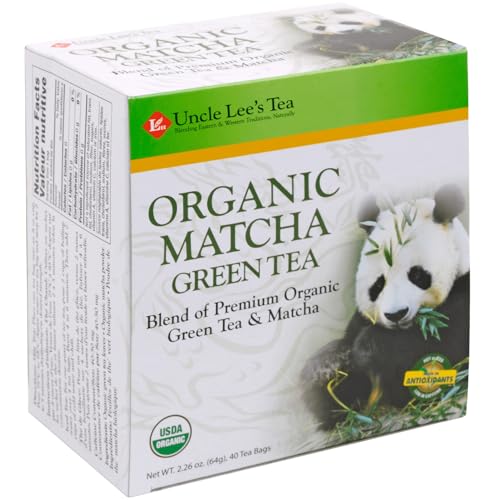
Uncle Lee's Organic Matcha Green Tea Bags
- Tea USDA organic green tea leaves with finely ground matcha
- Count 40 bags
- Wrapping Individually wrapped
- Brewing Hot or cold brew (per listing)
Uncle Lee's is an affordable way to get organic matcha green tea in individually wrapped bags. The listing describes USDA-certified organic green tea leaves with "a touch of" finely ground matcha for a richer taste, which is an honest description of what most matcha tea bags are: green tea first, matcha second.
The individual wrappers make these a good choice for an office drawer, a lunch bag or travel, where an open box would go stale. Uncle Lee's suggests brewing them hot or as a cold brew over ice; for cold brew, leave two bags in a jar of cold water in the fridge for several hours.
The title also describes the tea as low caffeine. Treat that as relative: green tea and matcha both contain caffeine, and the listing does not give a figure. If a strong matcha flavour is what you are after, a blend with more matcha in it, or matcha powder, will suit you better.
- Organic at a budget price
- Individually wrapped bags
- Works hot or as a cold brew
- Only "a touch of" matcha, so the matcha flavour is mild
- No caffeine figure on the listing
Best for: An affordable, organic, individually wrapped green tea with a little matcha.
Skip if: You want a pronounced matcha taste.

Celestial Seasonings Matcha Green Tea
- Tea Green tea blended with traditional Japanese matcha
- Count 20 bags
- Additives No artificial flavours, colours or preservatives (per listing)
- Packaging Recycled box, stringless bags
- Diet Gluten free, contains caffeine
Celestial Seasonings is a familiar supermarket brand, and this small box is the lowest-commitment way to find out whether you like matcha tea bags. According to the listing, it is a blend of fine green tea and traditional Japanese matcha, with no artificial flavours, colours or preservatives, and it is gluten free and contains caffeine.
The brand uses recycled boxes and stringless tea bags to cut down on packaging waste. With only 20 bags in the box, it is a trial size rather than a long-term supply, and it costs more per bag than the 50 and 100-count options here.
It is not labelled organic and the listing does not describe the bag shape or wrapping. It is sold and shipped by Amazon.com, so it is easy to add to an order.
- Small, inexpensive box to try matcha tea bags
- No artificial flavours, colours or preservatives (per listing)
- Recycled box and stringless bags
- Sold and shipped by Amazon.com
- Only 20 bags, so higher cost per bag
- Not labelled organic
Best for: Trying matcha tea bags for the first time.
Skip if: You already know you like them; a 50 or 100-count box is better value.
Matcha tea bags vs matcha powder
The two are made from the same plant, but they are drunk in completely different ways, and that changes almost everything about the cup.
What is in the bag
Matcha powder is shade-grown tea leaf, stemmed, deveined and stone or ball milled into a fine powder. A matcha tea bag usually contains ordinary green tea leaves, often sencha, with matcha powder added to coat the leaves and deepen the colour and flavour. None of the brands here states the exact ratio, and wording like "a touch of matcha" is a useful clue that the base tea dominates.
How you drink it
With powder, you whisk the whole leaf into water and drink all of it. With a tea bag, you steep the leaves and throw them away, so only what dissolves into the water ends up in your cup. That is why a tea bag cup is thin and clear, while matcha is opaque, creamy and frothy.
Taste and caffeine
Matcha tea bags taste like a slightly richer, greener green tea. A serving of matcha powder is more intense, with more umami and more body. Because you drink the whole leaf, a full serving of matcha powder generally contains more caffeine than a cup of green tea from a bag, although both vary by tea and brewing. For more on the differences, see matcha vs green tea and matcha vs sencha.
Cost and convenience
Tea bags are much cheaper per cup and need nothing but hot water. Powder costs more but gives you the real drink, plus lattes and recipes. If you want powder's convenience without a whisk, single-serve matcha packets sit between the two.
What to look for in matcha tea bags
The base tea and the matcha
Look for a clear description of what the matcha is blended with. Sencha, a steamed Japanese green tea, is the classic base and pairs naturally with matcha. Japanese-origin matcha is a good sign, though tea bag listings rarely say much about grade. If a strong matcha flavour is your priority, a listing that leads with matcha rather than green tea is a better bet.
Organic certification
Four of the six teas here are labelled organic, three of them with USDA Organic certification stated on the listing. Certification tells you about how the tea was farmed, not how it tastes, but it matters to many tea drinkers, and green tea is a crop where people often prefer organic. Look for the USDA Organic seal and, ideally, the certifier's name, as FGO gives.
Bag shape and material
Pyramid bags, like Ito En's organic version, give the leaves more room to expand, which tends to give a fuller infusion. Flat paper bags are more compact. If you care about what touches your tea, check the material: FGO's abacá fibre bags and The Republic of Tea's unbleached round bags are free of strings, staples and, in FGO's case, glue and bleach, according to their listings.
Individually wrapped or not
Matcha powder is sensitive to air, light and humidity. Individually wrapped bags (Ito En Organic, Uncle Lee's) stay fresher for longer once the box is open, and they travel well. Unwrapped bags in a resealable pouch or tin (FGO, The Republic of Tea) create less waste but rely on you sealing the container properly.
Count and cost per cup
Boxes here range from 20 to 100 bags. Divide the price on the card by the count to compare. Small boxes are good for trying a brand; if you drink green tea daily, a 50 or 100-count pack is better value.
How to brew matcha tea bags
Hot
- Heat the water to 75–80°C (165–175°F). Boiling water scorches green tea and makes it bitter. Without a thermometer, let a just-boiled kettle rest for about three minutes. A temperature-control kettle makes this easy.
- Use about 8 oz (240 ml) of water per bag. More water makes a thin cup.
- Steep for 1 to 3 minutes. Start at 2 minutes and adjust. Longer steeping adds strength but also bitterness.
- Remove the bag without squeezing it. Squeezing pushes out bitter tannins.
- Stir before drinking. Some matcha powder settles at the bottom of the cup.
Iced
Brew double strength: two bags in 8 oz of 75–80°C water for 2 to 3 minutes. Remove the bags and pour straight over a tall glass of ice. The ice dilutes the tea to normal strength and chills it quickly, which keeps the colour bright.
Cold brew
Put two or three bags in a jar with about 16 oz (500 ml) of cold, filtered water and refrigerate for 6 to 8 hours. Cold brewing extracts less bitterness, so the tea comes out smooth and naturally sweet. Remove the bags and keep the tea in the fridge for a couple of days.
A tea bag latte
For a light, quick latte, steep two bags in about 4 oz of 80°C water for 3 minutes, remove them, then top with steamed or frothed milk and a little honey. It will be milder than a latte made with matcha powder, but it is a pleasant drink with no whisk.
Common mistakes, and how to store tea bags
- Boiling water. The single biggest cause of bitter green tea. Let the water cool.
- Steeping too long. Leaving the bag in for five minutes or more makes the tea harsh. Set a timer.
- Hard or reboiled water. Very hard water dulls green tea flavour; FGO also recommends against reboiling. Fresh, filtered water makes a noticeable difference; see the best water filter for tea.
- Expecting matcha powder. A tea bag will not make a thick, frothy drink. Judge it as a green tea.
Store tea bags in a cool, dry, dark cupboard away from the stove, spices and coffee, because tea absorbs strong smells. Keep opened boxes and pouches sealed tight; if the box has no seal, move unwrapped bags into an airtight tin. Use them by the best-by date, and ideally within a few months of opening, while the green colour and fresh flavour last.
Side-by-side comparison
| Tea bags | Blend | Organic | Bags | Count | Best for |
|---|---|---|---|---|---|
| ITO EN Organic | Matcha and sencha | Yes | Pyramid, individually wrapped | 50 | Best all-round |
| Ito En Traditional | Matcha green tea | Not labelled | Not stated | 50 | Value |
| Republic of Tea Double Green | Green tea and Japanese matcha | Yes | Round, unbleached, stringless | 50 | Clean, minimal bags |
| FGO Organic Matcha + Green Tea | Japanese matcha and green tea | Yes | Abacá fibre, stringless | 100 | Bulk |
| Uncle Lee's Organic | Green tea, touch of matcha | Yes | Individually wrapped | 40 | Budget organic |
| Celestial Seasonings | Green tea and Japanese matcha | Not labelled | Stringless | 20 | Trying it |
Frequently asked questions
Are matcha tea bags real matcha?
They contain real matcha powder, usually blended with green tea leaves such as sencha. You steep and discard the bag, so you drink an infusion rather than the whole ground leaf as you do with matcha powder.
Are matcha tea bags as good as matcha powder?
They are a different drink. Tea bags make a lighter, clearer green tea with some matcha flavour, and they are cheaper and easier. Matcha powder makes a thicker, more intense drink and works for lattes and recipes.
Do matcha tea bags have caffeine?
Yes, because green tea and matcha both contain caffeine. A cup from a tea bag usually has less caffeine than a full serving of matcha powder, since you do not drink the whole leaf.
How long should you steep a matcha tea bag?
About 1 to 3 minutes in water at 75 to 80°C. Start at 2 minutes. Steeping longer or using boiling water makes the tea bitter.
Can you cold brew matcha tea bags?
Yes. Put two or three bags in about 500 ml of cold water and refrigerate for 6 to 8 hours. Cold brewing gives a smooth, less bitter tea.
Can you make a matcha latte with tea bags?
You can make a light version. Steep two bags in a small amount of hot water for about 3 minutes, then add steamed milk. It will be milder than a latte made with matcha powder.
Find matcha cafés near you
Taste great matcha before you buy: find the best matcha cafés in your city.
Find Matcha Near Me